How Did Prashant Kishor Disrupt Bankipur?

I recently wrote a LinkedIn post on my initial observations from Prashant Kishor's maiden electoral victory as a politician. One of my college professors told me not to be so loose and instead come up with a deep dive on what led to the victory of Prashant Kishor in the Bankipur By-Election 2026. He told me think more as a political consultant and not as a psephologist.

So, to comprehend the magnitude of the Jan Suraaj Party's market penetration in Bankipur constituency, it is essential to first establish the demographic and historical baseline of the constituency. In political terms, Bankipur represents a unique, highly concentrated urban market characterized by high barriers to entry for non-incumbent actors. Since 1995 (formerly delineated as Patna West), the Bankipur seat operated as an uninterrupted monopoly for the BJP. The constituency's political identity was inextricably linked to a single political family: the late Navin Kishore Prasad Sinha and, subsequently, his son, Nitin Nabin. Nitin Nabin had maintained a formidable electoral grip, winning the reconstituted Bankipur seat in 2010, 2015, 2020, and 2025. In the 2025 Assembly election, Nabin secured 98,299 votes, commanding a dominant 62.66% vote share and defeating his nearest RJD rival by a margin of 51,936 votes.
Now let's dissect the constituency on the basis of caste.
Kayasthas, Bhumihars, Brahmins, and Rajputs collectively account for approximately 50% of the electorate. They are the upper-caste and forms the incumbent core. This bloc has historically formed the bedrock of the BJP’s support base, prioritizing cultural alignment and the fear of RJD resurgence over localized civic grievances.
Muslims and Chandravanshis constitute nearly 20% of the electorate, while Yadavs form another critical bloc. They are the Minorities and OBCs thereby forming the opposition core. These segments have traditionally aligned with the RJD-led Mahagathbandhan.
There are fractional segments like Vaishyas, Dalits, Kurmis, and Kushwahas. They constitute smaller fractional segments of 3% to 8% each, alongside an 8.04% Scheduled Caste (SC) voter base.
The August 2026 by-election witnessed a suppressed voter turnout of 34.30%, a contraction of over 7 percentage points compared to the 41.35% registered in the 2025 Assembly elections. Despite this low turnout, the velocity of vote share transfer was unprecedented.
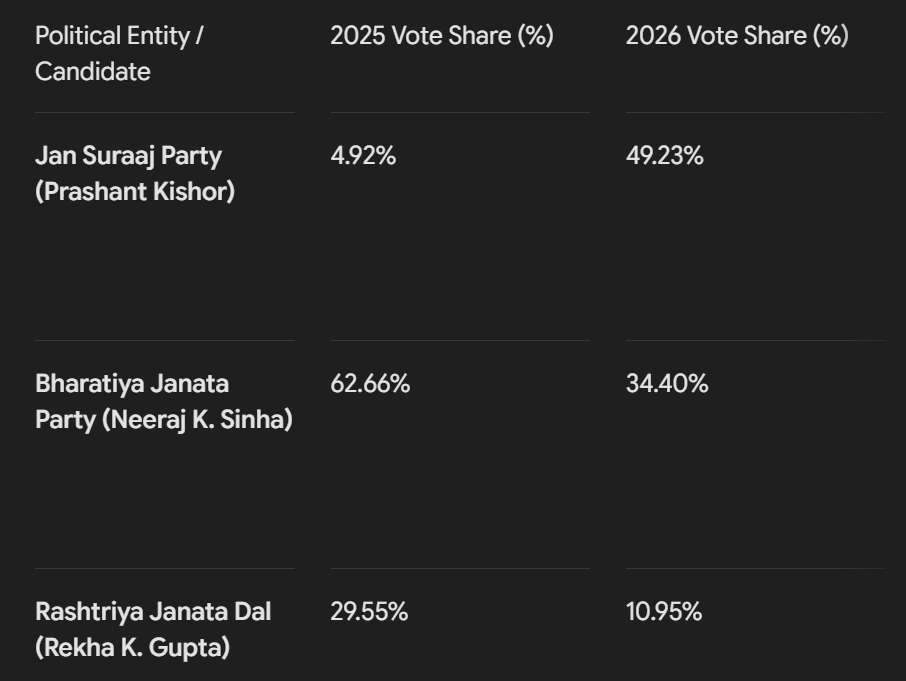
The data confirms a bipartite attrition model. The JSP did not merely consolidate the anti-incumbent vote; it successfully destroyed core voter bases from both the BJP and the RJD.
1. The Challenger Playbook: Operational and Strategic Drivers of the JSP
Prashant Kishor’s capture of Bankipur was the result of a meticulously engineered, data-driven political operation. Following the November 2025 Bihar Assembly elections where the JSP contested 238 seats, won zero, and secured a state-wide vote share of just 3.44%; the party faced an existential crisis. The response to this failure was a textbook exercise in corporate restructuring and agile methodology.
1.1 The "Lean Startup" Model
Immediately following the 2025 defeat, the Jan Suraaj Party executed a ruthless dismantling of its bloated legacy architecture. The party dissolved all traditional committees from the state level down to the district, block, and booth levels, recognizing that mirroring the hierarchical structures of the BJP and RJD was highly inefficient for a challenger brand. In its place, Kishor deployed a highly agile, specialized operational matrix. The Bankipur campaign was orchestrated by a tightly controlled core team of approximately 100 staff members.
This core group was subdivided into specialized, outcome-oriented operational units -
Booth Management Unit: Tasked with mapping and securing a presence across the 422 polling booths in the constituency.
Caste Outreach Unit: Designed to navigate the complex social demographics of Patna and subtly fracture the BJP’s upper-caste hegemony through targeted messaging.
Women’s Voter Unit: Focused exclusively on intensive, door-to-door mobilization of female voters, a demographic traditionally loyal to the NDAs welfare ecosystem.
Campaign Analytics Unit: Deployed for real-time tracking of voter sentiment, micro-targeting, and resource allocation.
By replacing the traditional cadre model and establishing these specialized professional units, the JSP achieved operational superiority. It effectively built an electoral organization while simultaneously executing an election campaign. This is indeed a highly complex maneuver in Indian regional politics.
1.2 First-Mover Advantage and Hyper-Local Micro-Targeting
Recognizing that the incumbent BJP and RJD would rely on their entrenched networks and launch macro-campaigns late in the electoral cycle, Kishor capitalized on incumbent lethargy. The JSP initiated its ground operations nearly two months before its rivals formally launched their campaigns, establishing a critical first-mover advantage.
Operationally, the JSP rejected the standard political theater of massive, impersonal rallies. Instead, Kishor executed a granular, ward-level strategy. The daily operational cadence was disciplined and segmented.
Youth volunteers deployed to public parks, local tea stalls, and the Gandhi Maidan to engage early risers, fitness enthusiasts, and students.
Specialized women's teams knocked on doors across residential neighborhoods, targeting homemakers.
Kishor personally conducted padyatras (foot marches) and localized neighborhood interactions deep into the night, signaling accessibility and grassroots commitment.
Strategically, Kishor decoupled his narrative from grand ideological state-level debates. In a 100% urban constituency, he focused strictly on acute civic pain points: persistent waterlogging, crumbling road infrastructure, severe traffic congestion, and local educational deficiencies. This hyper-local product offering resonated deeply with an urban middle class that had grown fatigued by sweeping state-level political rhetoric that failed to improve their immediate quality of life.
1.3 Acquisition of the Gen-Z and First-Time Voter Demographic
A critical differentiator in the JSPs market acquisition strategy was the aggressive targeting of first-time and Gen-Z voters. Bankipur’s electorate includes a substantial segment of youth, with approximately 53,419 voters in the 18-29 age bracket.
The BJPs traditional value proposition in Bihar relies heavily on the juxtaposition of its governance against the Jungle Raj of the RJD era in the 1990s. However, the Gen-Z demographic possesses no lived memory of the 1990s; thus, the fear-based marketing of the NDA is fundamentally ineffective on this cohort. The JSP positioned itself as a modern, forward-looking alternative, framing the election as a choice regarding education, industrialization, and ending the compulsion of outbound migration for low-wage jobs. By pivoting the conversation to future state-capacity rather than historical grievance, Kishor successfully monopolized the youth vote.
1.4 Dismantling the Anti-RJD Fear Premium
For decades, the NDA in Bihar enjoyed a structural electoral advantage which we can call "a fear premium". A substantial segment of urban, upper-caste, and Extremely Backward Class (EBC) voters supported the BJP not necessarily out of an absolute endorsement of its governance, but out of a deep-seated fear of the return of the RJD.
Kishor systematically neutralized this psychological barrier. He recognized that as long as voters believed defecting from the BJP would inadvertently empower the RJD, the BJP remained invincible. By aggressively establishing the Jan Suraaj Party as a viable, non-RJD alternative, Kishor lowered the psychological cost of defection. Disenchanted BJP supporters realized they could register their protest against the incumbent government without risking the resurrection of the Mahagathbandhan.
2. The BJPs Structural and Strategic Decay
The collapse of a 30-year political fortress requires more than an agile challenger; it necessitates systemic decay and strategic miscalculations by the incumbent. The BJPs performance in Bankipur exposed deep-seated organizational, leadership, and operational vulnerabilities.
2.1 The Samrat Choudhary Referendum and the Loss of the Protective Shield
The macro-political environment of Bihar fundamentally altered in April 2026. Following the resignation of long-serving Chief Minister Nitish Kumar (who transitioned to the Rajya Sabha), Samrat Choudhary assumed office, marking the first time the BJP held the states top post in its own right.
Historically, the NDAs electoral machinery in Bihar was insulated by the personal credibility of Nitish Kumar. Even when governance faltered, the public perception remained that the administrative system ultimately answered to Kumar, providing a protective shield that absorbed public dissatisfaction. With Kumar's withdrawal from day-to-day state politics, this shield evaporated.
The Bankipur by-election was the first electoral contest under Choudhary's direct leadership, forcing the BJP to contest entirely on its own governance record. Prashant Kishor astutely capitalized on this leadership vacuum by projecting the by-election as a direct referendum on the Samrat Choudhary government. Four months into his tenure, Choudhary had yet to consolidate the administrative authority and public trust that his predecessor commanded. The electorates experience of persistent bureaucratic inertia, delayed decision-making, and unresolved law-and-order controversies sharply contradicted the BJPs promises of decisive administrative transformation.
2.2 Supply Chain Failure: Candidate Selection and Brand Dilution
The BJPs initial complacency, followed by reactive panic, was glaringly evident in its candidate selection process. This was a critical failure in political product placement. Assuming an easy victory in a historically safe seat vacated by its National President, the party's strategic clarity wavered.
Initially, the BJP fielded Abhishek Kumar Sinha (popularly known as Bunty). However, following internal pushback and public controversy surrounding his bio-data and familial background, the party abruptly forced his withdrawal. In a rapid, reactive move, the ticket was reassigned to Neeraj Kumar Sinha, a 32-year-old former booth-level worker and youth wing leader.
This mid-stream candidate swap broadcasted profound organizational unease and instability as Kishor’s campaign gathered momentum. Furthermore, replacing a legacy heavyweight brand like Nitin Nabin with a relatively unknown, first-time candidate in a highly educated, sophisticated urban constituency was perceived by the electorate as arrogant. The voters interpreted this as the BJP taking their loyalty for granted, operating under the assumption that a dog or a cat could win on the party symbol.
2.3 Misallocation of Resources: Macro-Theater vs. Micro-Engagement
In stark contrast to the JSPs granular ground campaign, the BJP relied heavily on traditional, top-down political theater. Treating the by-election as a prestige battle, the central and state leadership deployed an army of approximately 40 star campaigners. This high-profile roster included Union ministers, state ministers, CM Samrat Choudhary, and regional heavyweights like Chirag Paswan, Ravi Shankar Prasad, and Manoj Tiwari.
From a consulting perspective, this represents a severe misallocation of resources.
Deploying macro-level figures to solve micro-level electoral attrition is highly inefficient. The BJPs reliance on large bike rallies, Adhivakta Samwads (advocate dialogues), and Chikitsa Samwads (medical dialogues) proved far less effective than the JSPs continuous, localized, door-to-door engagement. The heavy top-down presence only served to highlight the party's desperation without fundamentally altering voter sentiment on the ground.
2.4 Brand Erosion via State Machinery Coercion
The final phases of the election were marred by allegations of administrative overreach, severely damaging the BJPs brand positioning as a party of good governance. On the eve of the election, Prashant Kishor formally accused the Patna Police of acting as an extension of the ruling party, alleging they illegally detained over 16 Jan Suraaj campaign workers without formal records. Kishor claimed this was a targeted, systemic attempt to intimidate voters and cripple the JSPs booth-management capabilities on election day.
Conversely, the BJP accused JSP workers of attempting to compromise polling integrity by casting fraudulent votes, urging the Election Commission to intervene. Regardless of the strictly legal veracity of these claims, the optics of the state police machinery heavily intervening against a challenger reinforced Kishor’s narrative: an incumbent government, devoid of popular support, resorting to authoritarian desperation to maintain its monopoly.
3. The Bharat Tiwari Encounter
Political realignments of this magnitude rarely occur in a vacuum; they are typically catalyzed by specific, emotionally resonant "black swan" events that shatter established narratives and alienate core demographics. In the Bankipur by-election, the extrajudicial killing of Bharat Bhushan Tiwari in the neighboring Bhojpur district served as this critical inflection point.
3.1 Deconstructing the Bhojpur Incident
On June 17, 2026, Bharat Bhushan Tiwari, a 28-year-old student and social activist from Bilauti village in the Bhojpur district, was killed in what was widely perceived as a staged police encounter. Tiwari, who had gained local prominence advocating for the rehabilitation of flood-affected residents, became engaged in a standoff with the Shahpur Police and the Special Task Force (STF) over the alleged possession of an unlicensed firearm.
The incident achieved immediate statewide notoriety because Tiwari live-streamed his surrender on Facebook. In the broadcast, he was seen demanding the completion of local development projects before stating his intention to disarm, subsequently tossing his weapon toward the police personnel. Despite clearly surrendering on camera, Tiwari was shot five times by the STF.
The subsequent public outrage was immense, fracturing trust in the state's law enforcement apparatus. Under immense pressure, the Bihar government was forced to order a judicial inquiry headed by a retired High Court judge. Following the inquiry's preliminary findings of "excessive force," the state suspended multiple police officers, transferred the Jagdishpur Deputy Superintendent of Police, and arrested STF constable Akshay Kumar, booking him under Section 103(1) of the Bharatiya Nyaya Sanhita (BNS) for murder.
3.2 Alienation of the Upper-Caste Core
The political fallout from the Tiwari encounter was devastating for the BJP's traditional base. Tiwari was a Brahmin, and his killing triggered a visceral, widespread anger among the Brahmin, Rajput, and Bhumihar communities. These castes that have historically served as the ideological and electoral backbone of the BJP in central Bihar, including the Bankipur constituency.
Chief Minister Samrat Choudhary’s overarching political strategy had relied heavily on aggressive OBC (Other Backward Class) consolidation, paired with a rhetoric of uncompromising law and order (often citing the success of military-style operations).
However, the graphic nature of the Tiwari encounter shattered this narrative. The upper castes perceived the state's policing apparatus as acting with unchecked impunity against their specific communities, creating a deep sense of alienation, betrayal, and persecution. The BJP, having lost a generation of influential upper-caste leaders who previously managed these social fault lines, found itself entirely unequipped to pacify the outrage.
3.3 Weaponization in the Bankipur Campaign
Prashant Kishor immediately recognized the strategic utility of the Bhojpur incident and integrated it into his core campaign messaging. Bankipur, with its massive concentration of upper-caste voters, was highly sensitive to the caste dynamics playing out in neighboring districts.
Kishor consistently raised the Bharat Tiwari encounter during his public meetings, refusing to accept the official police version of events and explicitly framing it as a "murder" indicative of the state government's systemic failure and anti-Brahmin bias. By repeatedly highlighting this issue, Kishor provided aggrieved upper-caste BJP voters with a socially acceptable, immediate rationale to vote against their traditional party. The JSP transformed from a mere political startup into the primary vehicle for upper-caste protest against the BJP's new OBC-centric leadership transition.
4. RJD’s Market Share Erosion
While the narrative surrounding the BJP's defeat dominates the headlines, the total marginalization of the Rashtriya Janata Dal (RJD) in Bankipur carries equally profound implications for the state's political equilibrium. The RJD's inability to capitalize on incumbent weakness reveals a critical erosion of its core product offering.
4.1 The Fragmentation of the Muslim-Yadav (M-Y) Alliance
The RJD's political identity and electoral viability have long rested on the formidable Muslim-Yadav (M-Y) coalition, a social engineering marvel crafted by Lalu Prasad Yadav in the 1990s. Post-poll studies from the 2025 Assembly elections demonstrated that this alliance remained largely intact statewide, with nearly 74% of Yadavs and 70% of Muslims backing the RJD.
However, in the urban crucible of Bankipur, this monolith fractured completely. RJD candidate Rekha Kumari Gupta finished a distant third, securing only 14,273 votes (10.95%). This represents a catastrophic drop from the 46,363 votes (29.55%) she secured just a year prior in the 2025 elections. Furthermore, the conspicuous absence of the RJD's chief ministerial face, Tejashwi Yadav, from the campaign trail, amidst accusations by NDA leaders like Chirag Paswan that he was vacationing abroad during the critical phases of the by-election, projected a severe lack of seriousness and leadership at the top of the Mahagathbandhan.
4.2 Tactical Voting and Ideological Decoupling
The primary driver of the RJD's collapse was aggressive tactical voting by the Muslim electorate. The analysis indicates that Muslim voters in Bankipur executed a cold, strategic calculation rooted in electoral arithmetic rather than historical ideology or blind loyalty.
Recognizing that the RJD was failing to mount a credible organizational challenge against the BJP, the minority electorate identified Prashant Kishor and the JSP as the most viable, mathematically sound instrument to defeat the incumbent. This shift indicates a critical ideological decoupling: anti-BJP minority voters are no longer irrevocably bound by brand loyalty to the RJD. If a credible, highly competent alternative emerges that demonstrates the organizational capacity and ground game necessary to defeat the NDA, minority voters are willing to defect en masse. By capturing this minority demographic while simultaneously siphoning off disgruntled upper-caste Hindu voters grieving the Bharat Tiwari encounter, Kishor achieved a rare, highly potent voter convergence that effectively bypassed the traditional caste barriers of Bihar politics.
5. Second and Third-Order Strategic Implications
The Bankipur result is not merely an isolated localized data point; it generates substantial ripple effects across the value chain of Bihar politics, altering the strategic calculus for all major stakeholders ahead of future state-wide and national electoral cycles.
5.1 Implications for BJP National Leadership and Internal Dynamics
The defeat carries severe symbolic and organizational repercussions for BJP National President Nitin Nabin. Losing a home bastion that his family had controlled continuously since 1995, just months into his tenure as national president, fundamentally undermines his reputation as an electoral strategist and grassroots organizer.
While this singular loss does not threaten the NDA's current mathematical majority in the Bihar Assembly (standing at a highly comfortable 201 out of 243 seats), it significantly reduces Nabin's internal political capital. Political analysts suggest this loss may drastically diminish his influence in crucial internal decision-making processes, particularly ticket distribution and strategic planning for upcoming, high-stakes assembly elections in Uttar Pradesh, Gujarat, and other states. Paradoxically, a weakened party president often suits the central high command, potentially making Nabin a more "manageable" figurehead who relies heavily on central intervention rather than autonomous regional strength.
Furthermore, Kishor's explicit framing of the verdict as a direct message to Prime Minister Narendra Modi and Home Minister Amit Shah to "appoint an honest, capable and credible Chief Minister" deliberately bypasses local leadership. This forces the central command to re-evaluate whether Samrat Choudhary possesses the necessary political gravity to lead the state into the next general elections.
5.2 The Viability of a Third Front and Future Alliance Formations
The most enduring strategic question post-Bankipur is whether the Jan Suraaj model can scale across the agrarian, deeply caste-stratified, and sprawling landscape of rural Bihar. Bankipur is an extreme outlier as it is highly urban, highly educated, and disproportionately upper-caste.
5.3 Governance as the New Electoral Currency
Finally, the Bankipur verdict signals a maturation of voter expectations in urban Indian markets. Kishor’s success in rejecting the traditional reliance on caste arithmetic and free-ration welfare schemes in favor of emphasizing industrialization, healthcare, state-capacity, and education indicates a shifting demand curve in the political market. Electorates, particularly in highly connected urban nodes, are increasingly factoring administrative competence and immediate civic delivery into their voting calculus.
The incumbent BJP can no longer rely on the specter of the RJD's 1990s history to mask current administrative inertia. The protective shield has fallen, and political survival now hinges on measurable, hyper-local governance outcomes.
The Bankipur by-election of August 2026 marks a watershed moment in the political trajectory of Bihar, providing a definitive blueprint for how entrenched political monopolies can be disrupted by agile, data-driven challenger brands.
Prashant Kishor’s victory was achieved not through ideological grandstanding, but through the deployment of a highly optimized campaign infrastructure that capitalized on the incumbent's strategic lethargy, supply-chain failures in candidate selection, and leadership transition vulnerabilities.
What all we can learn from this?
For the Incumbent (BJP): The immediate strategic imperative is to aggressively accelerate administrative delivery and visible governance outcomes to validate the leadership of Chief Minister Samrat Choudhary. The party must recalibrate its crisis management protocols regarding law enforcement to prevent further alienation of its upper-caste core. Furthermore, relying on legacy brand equity and top-heavy macro-campaigns is no longer a viable defense against hyper-local micro-targeting.
For the Challenger (JSP): While the Bankipur victory validates the "lean startup" campaign methodology, the model remains untested in rural, agrarian theaters. The JSP must now focus on scaling its organizational capacity to acquire the necessary geographic footprint required for statewide dominance, without diluting its core governance-centric value proposition.
For the Principal Opposition (RJD): The total erosion of the M-Y alliance in this constituency indicates a terminal decline in brand loyalty among minority voters. The RJD must urgently undergo internal restructuring, elevate visible and consistent leadership, and expand its product offering beyond legacy social justice rhetoric to include modern economic and administrative competence, or risk permanent marginalization by emerging third-front actors.


Comments